Showing posts with label Kruger National Park. Show all posts

Tuesday, 27 June 2017

Part 3 – Letaba, Orpen area, Hoedspruit and Pretoriuskop (May 2017)

African Wildlife and Nature Photographs – (7 provinces in a 7 week trip around South Africa)


Part 3 – Letaba, Orpen area, Hoedspruit and Pretoriuskop (May 2017)

Our stay in Letaba camp was in one of their permanent tents, as we were just staying for one night. These tents are great, not too expensive and serviced by a few ablutions. No utensils provided but there is power and a fridge/freezer. 

Breaking from the usual evenings cooking we decided to eat at the Letaba camps main restaurant and even though the restaurant is going through management changes (again) we were very pleased with the service and great meal we both had. We would therefore, at the time of writing, recommend the main restaurant at Letaba rest camp if you want a simple coffee, breakfast or a 3 course meal, good food at reasonable prices can be had.

We left Letaba early in the morning and traveled further south as we were due to have our first nights stay at Tamboti tented camp but for various reasons, we ended up staying in a chalet at Orpen Camp, which is just a stones through away from Tamboti. As we had stayed there before we were aware of the ‘resident’ honey badger that does the rounds every night raiding cupboards and dustbins. All cupboard doors and draws have locks on them and when checking-in you are warned not to leave any food out and even to keep your garbage out the bins until the morning.

We had only deposited a plastic wrapper, two teabags and an empty 5L bottle of water in our bin but decided to see what would happen so we placed the bin in an area where we could then set up our camera trap. True to form, the honey badger paid a visit. Firstly, it seemed to take off with a tea bag and then at 4am we both woke to a strange noise. Peeking outside with the torch there was said honey badger wrestling with the empty 5L bottle of water. Just gotta love them for their no-care attitude.
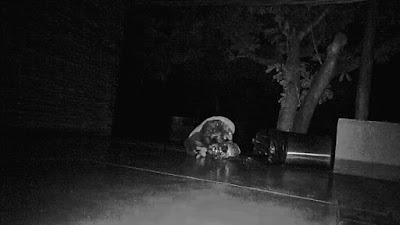
Honey Badger
Honey Badger and the water bottle at Orpen camp
We heard via friends later that day that people who stayed at Tamboti tented camp had a honey badger raid their cooler box. We were astounded to hear it got away with yogurt, cheese and wine! Seems honey badgers tastes are improving. Glenda was wondering if it was in-fact the same honey badger who then came to visit us, (the camps are close in honey badger terms) and perhaps it needed the water after the wine…..


Outside Orpen camp there is a very nice water hole in front of the camp and the general public can view the Orpen Webcam via the internet.

When we arrived there were a few African Elephant (Loxodonta africana) drinking and there was a steady stream of plains game Burchell’s Zebra (Equus burchellii), Impala (Aepyceros melampus),and Blue Wildebeest (Connochaetes taurinus) etc coming through to quench their thirst.

Scene of the Blyde River
Blyde River
We left Orpen in the morning as the following 2 nights / 3 days were spent in Hoedspruit, catching up with old friends and joining our old bird club on their monthly Saturday outing. Great to see many members at the outing and we had a great walk along the Blyde River and being pleasantly surprised by how many species we managed to spot, considering it was mid May. Highlight for a new member was a lifer (first time a bird has been seen by a person) in the form of a male Narina Trogon (Apaloderma narina).

Glenda and I were invited to stay with goods friends on the wildlife estate we used to live in (Raptor's View Wildlife Estate) and made the most of being in the bush and placing our camera trap near their birdbath. Great to see overnight visitors of porcupine, Small-spotted Genet (Genetta genetta), Common Duiker (Sylvicapra grimmia) and two duelling male Nyala (Tragelaphus angasii).

All to soon it was then time to head back into the Kruger National Park and we managed to finally stay in the permanent tents at Tamboti camp overnight. As with Letaba tents they are very comfortable but a little more secluded, they are located on a dry riverbed and there are only 40 tents in total with a central ablution block and shared kitchen area. You certainly feel like you are alone in the bush when staying at these ‘bush’ camps. 


The bush is quite thick around the camping area and we gather in summer it is great for birding. It will be on the list to return to and perhaps spend more time there as we had to make an early start the following day to get to Pretoriuskop Rest Camp.

Tented Camp, Tamboti
Our tent at Tamboti camp
The Kruger Park gets a bit busier when going down to its Southern parts, both with people and animals but we were pleased to finally get to see a pride of 5 Lions (Panthera Leo) on the road between Pretoriuskop and Phabeni gate, especially seeing that we had heard lions roaring most nights. 

It was a good area for us as we then had two good leopard sightings soon after, one with a kill (Impala) which it had managed to drag up a tree reasonably close to the road. 


I managed to practice some macro photograph by finding some butterflies close to the camper, follow the link where you can see the results of my macro photography.

Again …. Time for a little moan about the camping at Pretoriuskop. The camping site is split into two sections and it has always been reasonably comfortable, but now most of the lower camp and a third of the upper camp have been taken over by a tented concession with their permanent tents. Why, I ask !!! It seems the same number of campers can book at the camp but now there is less space. We eventually found a spot near the fence but it was also close to the ablutions, which meant we had people wandering past us at all hours of the night. We were not happy camper ! 

After a pleasant stay in the southern part of the Kruger National Park it was time to head back to Johannesburg to stock up and head off for the next part of our travel. 


Wednesday, 7 June 2017

Part 2 – Phalaborwa and Punda Maria (May 2017)

African Wildlife and Nature Photographs – (7 provinces in a 7 week trip around South Africa)

Part 2 – Phalaborwa and Punda Maria (May 2017)

As we mentioned in part 1 prior to staying in the Kruger National Park, we spent 3 nights at the Forever Resort in Phalaborwa, due to the park being full. However, this gave us chance to visit friends in Phalaborwa we hadn’t seen in years and allowing us a day visit into the park to Letaba rest camp, one of our favourite Kruger camps. 

The area around Letaba, and moving up to the Northern part of the park is dominated by Mopani bush, a favourite for the parks elephants and we were surprised at just how many elephants we were actually seeing. The most abundant large mammal species in the park are Impala (Aepyceros melampus), a staple diet of the large predators, however we kept saying we were seeing more elephants than impalas, so you can just imagine how many elephants we were seeing. Not that we were complaining as one can spend hours just watching the interaction between these African Elephant (Loxodonta africana) family members, especially when there is a breeding herd with very young calves.

African Elephant (Loxodonta africana) drinking
African Elephants at Punda Maria Waterhole - Kruger National Park
With most of the migrant birds having left South Africa, we were very surprised to find a pair of Woodland Kingfisher (Halcyon senegalensis) in Letaba Camp as these intra African migrants are usually gone at this time of the year (mid May).

South Africa and the Kruger Park have for the past 2 – 3 years suffered from a serious drought but this past year has seen a bit of a recovery in the park which has resulted in an inundation of Red-billed Queleas (Quelea quelea). In all the years we’ve been travelling into the park we have never seen quite so many flocks of Red-billed Queleas swooping through the trees in waves. It has been caused by the apparent late rains late last year and early this year and thus an abundant supply of grass seed.

Burchell’s Coucal - Centropus burchellii
Burchell's Coucal - one of the many
We were also pleased with the number of Southern Ground-Hornbill (Bucorvus leadbeateri) that we saw considering these are regarded as a vulnerable species in Southern Africa, they do however seem to be thriving in the Northern part of the Kruger National Park particularly. Another plentiful sighting were Burchell’s Coucal (Centropus burchellii) and in one day alone we counted 9 which for us was some sort of record. 

Eventually the day dawned for us to move into the Kruger Park and travel from Phalaborwa gate up north to the furthest camp, Punda Maria. Arriving there mid-afternoon after a pleasant drive, counting elephants and Burchell’s Coucals with sightings of the plains game species like, Impalas, Burchell’s Zebra (Equus burchellii) Giraffe (Giraffa camelopardalis) and a few Greater Kudu (Tragelaphus strepsiceros).

This was the first time we’d camped in Punda Maria having previously stayed in the chalets and permanent tents. The camp site is a real treat as the bird hide is located in the camp and it overlooks a beautiful waterhole.

While setting up camp a large herd of elephants came to drink, a great opportunity to take some photographs as they were bathed in soft golden afternoon sun a photographers dream. I stopped what I was doing and rushed to the bird hide to watch them. A fellow traveller advised me they’d been there every day for the last 4 days at the same time. As I was in the middle of setting up camp I thought I might as well catch them the following day. BIG MISTAKE, I was never to see them again in such numbers and in such awesome light in the whole 6 days we were there.. Great opportunity missed. (Lesson: Never leave for tomorrow what can be done today, take your opportunities as they arise). 


One small consolation was the small video footage I took on my mobile phone of the event, which I will share on my website www.africanwildlifeandnaturephotographs.com later. The elephants were constant visitors to the waterhole though and the sounds of elephants communicating in the middle of the night is quite something. Besides the elephants we were lucky to hear and fall asleep to lions roaring every night, but they proved to be elusive when trying to find them during the day.


The advantage of staying in Punda Maria is that it is only an hour’s drive to the Pafuri area, which is one of South Africa’s most prolific birding spots throughout the year , albeit missing the migrant birds in winter. Again, this trip didn’t disappoint with good sightings of African Crowned Eagle (Stephanoaetus coronatus), Martial Eagle (Polemaetus bellicosus) African Fish-Eagle (Haliaeetus vocifer), Meves’s Starling (Lamprotornis mevesii) White-fronted Bee-eater (Merops bullockoides) and White-crowned Lapwing (Vanellus albiceps), to name a few.

Martial Eagle - Polemaetus bellicosus
Martial Eagle at Pafuri - Kruger National Park
Now for a little moan and word of warning; so please take note…we enjoyed Punda Maria for its great location and the wonderful Mahonie Loop around the camp for late afternoon game drives, however the downside of the stay was that the camping was full, possibly overbooked and the camping area was like a car park in a shopping centre, but not as organised…. 

It’s a free-for-all for campers, hence people camping extremely close together, having access to power when not paid for with no control or checking by Sanparks who run the camp. We also soon realised that we were in a pensioner’s discount period (Sanparks have them a couple time a year) meaning there were far too many people camping in the Kruger Park due to its warm winter climate and no doubt cheaper utility costs. Unfortunately, in our opinion, not that interested in the parks wildlife either as some people just parked up and didn’t bother leaving camp, it would seem. 

Sanparks, Punda Maria camp is one camp that should have restricted camping numbers, frequent checking on who has camped where and paid for what. Sadly also there are too few ablutions based on the numbers allowed to camp with some in a poor state of maintenance and repair.

So it was time to say farewell to Punda Maria and head off further south to stay in Letaba and Orpen camps and visiting our previous ‘home town’ of the past few years; Hoedspruit.


Tuesday, 30 May 2017

Part 1 - Johannesburg to Phalaborwa (May 2017)


African Wildlife and Nature Photographs – (7 provinces in a 7 week trip around South Africa)

Part 1 - Johannesburg to Phalaborwa (May 2017)


Our trusted SUV and Camper for our trip 
So here we go, time to put fingers to the keyboard. We have been in South Africa for just over 7 days after leaving the Middle East, the first few days were spent in Johannesburg catching up with family and friends; gathering supplies and ensuring our SUV and our off-road camper, that will be our home for the next 7 weeks, had services. This, all before setting off on a 7 week tour of South Africa, covering 7 of South Africa’s provinces. 

Our planned trip will take us the whole length of the Kruger National Park in the North East of the country, endearingly known as the ‘bushveld’ or just plainly ’the bush’, to the far North West and the arid desert region of the Kgalagadi Transfrontier Park which at this time of the year (winter) has extreme cold at night. Then we will travel down to the Cape, along the beautiful Garden Route to Addo Elephant Park with many stops in-between. 

We hope you will follow our journey over the coming weeks on this blog, so come along and see beautiful South Africa with us an African Wildlife and Nature Photographs trip (7 Provinces in a 7 week trip around South Africa)

You can also follow us:
For stunning wildlife and nature photographs and interesting information about the subjects many of which we will meet and photograph along the way.


Don’t forget our website at www.africanwildlifeandnaturephotographs.com

We left Johannesburg on a Sunday which was a good idea as the roads were quiet but as we had a long journey ahead of us, we were on the road by 7:00am with a chilly temperature (in my wife’s opinion) of 11ºC, which we really felt as we'd left the Middle East in spring temperatures of around 40ºC.

Driving north on the main N1 highway towards our first few days camping at Phalaborwa in Limpopo province, we were soon doing a steady 'caravan towing' speed singing along to all the golden oldies that are played on various radio stations on a Sunday morning in South Africa.

First coffee stop after 2 hours of driving (yes you will come to learn we stop often for coffee) then 'On the Road Again' - our signature tune.

Our next stop was once we'd turned off the N1 travelling east was the Lewark Restaurant, outside Haenertsburg. We had a great brunch in a beautiful area, as now we were driving through some of South Africa most beautiful scenery around Magoebaskloof and Tzaneen in the Limpopo province. We pushed on to our final destination for the next few nights, this being the Phalaborwa’s Forever Resort.

Our camp set up (night shot) at the Phalaborwa Forever Resort
Our timings were perfect, arriving in ‘Phalaborwa’s Forever Resort’ at 2:30pm with a much warmer temperature of 30ºC. A bit too warm to set up camp, but as it was our home for the next 3 nights, we had time to relax, have an ice cream before the work of setting up camp began. 

We have yet been able to measure the length of time it takes us to set up our whole camping setup as we find camping a very friendly affair and your neighbours tend to come over and chat.

 I think people are just curious to check out our camping set up and do comparisons ! but also to find out who is travelling where, when and what have you seen on the road etc.

It was wonderful to be sleeping back in the 'bush' as we tend to sleep really well in the fresh air with the sounds of the African night including Pearl-spotted Owlets, Scops Owl and as we were just outside the Kruger National Park (this is our next stop) we could hear the whoops of Spotted Hyena and what was that sounds again .... Oh yes .....rutting Impalas.

Tuesday, 28 October 2014

Kori Bustard

Kori Bustard (Ardeotis kori)

Its big, in fact its the biggest flying bird in Africa, its the Kori Bustard (Ardeotis kori) and one of 4 species in the bustard family. African birds come in all shapes and sizes but the Kori bustard is unmistakable not only for its sheer size but also distinctive plumage which is interestingly coloured, being mostly grey and brown but finely patterned with black and white colouring.
With huge sexual dimorphism the Kori Bustard is Africa’s largest flying bird, the male Kori Bustard being twice the weight of the female, maybe the heaviest animal capable of flight and currently weighing typically between 7 kg – 18 kg (15 lb – 40 lb) which outstrips the Andean Condor where males weigh in at a small 11 kg -15 kg (24 lb to 33 lb). The physical size is just incredible, the male Kori Bustard  stands 71–120 cm (2 ft 4 in–3 ft 11 in) tall and has a wingspan around 230cm – 275 cm (8 ft – 9 ft )
A mainly ground dwelling omnivore (eats plants and or other animals, in this case mainly insects and small vertebrates..) the Kori Bustard can be found throughout Southern Africa where it can be seen slowly strutting through the veld in search of its food in open grassy areas, often characterized by sandy soil, especially like the Kgalagadi Transfrontier Park in South Africa but generally in low rainfall area’s.
During the mating season, these birds are usually solitary but for the breeding pair. Otherwise, they are somewhat gregarious, being found in groups often including 5 to 6 birds and generally silent but when the Kori Bustard is alarmed both the male and female birds let out a loud ‘growling’ type bark.
Kori Bustard (Ardeotis kori)
Kori Bustard (Ardeotis kori) - Kgalagadi Transfrontier Park - South Africa

Monday, 29 September 2014

Bushbuck

Bushbuck (Antelope)

Having a few days off this week, we headed into the Kruger National Park (South Africa). As is most times we enter the gates we wander on the first bird and or animal we will come across. More often or not its the common Impala (Aepyceros melampus) and this this got me thinking, although the most widespread antelope in the Kruger National Park by far, how did it fair in Sub-Sahara Africa? I must admit I was shocked to learn in fact in was the Bushbuck (Tragelaphus scriptus) and (Tragelaphus sylvaticus) that are the most widespread of the Sub-Saharan antelope.
I was further to learn that the Bushbuck were in-fact split into two species (as detailed above) which was something new to me. They are the kéwel(Tragelaphus scriptus) and the imbabala (Tragelaphus sylvaticus). The imbabala is related to the Bongo and the Sitatunga, and the kéwel to the Nyala. Here then in South Africa, the Bushbuck we refer to are (Tragelaphus sylvaticus related to the Bongo and the Sitatunga,  which occur from the Cape of South Africa through to Angola and Zambia.
That over with, other information about the Bushbuck. This antelope is found virtually in all habitats from woodlands to montane forest and rain forest. The Bushbuck found here are slightly bigger than the other species found further North and the colour differs quite substantially with difference in the spots and the stripes in both species but both species have light brown coats, with up to seven white stripes and white splotches on the sides in a variance.
The Bushbuck stands about 90cm (3ft) to the shoulder and depend on male or female weighs between 40-80 Kg (88-176 lbs) as their is sexual dimorphism.

Bushbuck (Tragelaphus sylvaticus) Female - Kruger National Park
South Africa

Monday, 8 September 2014

Steenbok

Steenbok (Dwarf Antelope of South Africa)

Steenbok (Raphicerus campestris) are one of South and Southern Africa’s smallest of antelope but what it lacks in size the Steenbok makes up for in its looks.
Being a beautiful reddish brown in colour, male Steenbok only stand between 40-60 cm (16-24 in)  high and weight in between 10-16 g (22-35 lbs) with the females being slightly smaller. In comparison to the rest of their bodies Steenbok have very long legs, other defining characteristic of the Steenbok is its very large ears and a black triangular patch on the bridge of the nose. You can further distinguish males from females as only males posses short straight black horns  or spikes really which stand about 150cm (6in) in length from the top of its head, large dark eyes, give way to preorbital glands.
Steenbok are solitary antelope and only really come together to mate, although breeding does take place throughout the year, births tend to peak in November and December each year which coincides with ‘Mother Natures re-birth’ (Spring) here in the Southern Hemisphere.
As with a few African antelope Steenbok are primarily browsers, (pick from trees and shrubs) feeding at or near ground level, occasionally they scrape the ground with their sharp hooves for roots and tubers. Water is not essential as moisture can be taken from the food they eat.
Steenbok have many different predators, including Leopard, Caracal and even Pythons, in the presence of danger, Steenbok first hide, crouching with the neck pressed against the ground and ears retracted to avoid detection. If the threat persists or approaches the animal will flee, with fast zig-zagging flight interrupted by attempts at concealment by lying down flat.
In South and Southern Africa the Steenbok’s distribution is wide and varied and can be found in various environments throughout South Africa, Botswana, Angola, Zambia, Kenya, Mozambique, Swaziland, Namibia, Tanzania and Zimbabwe.


Portrait of a Male Steenbok
Male Steenbook (Raphicerus campestris) showing his horns
large ears and 'preorbital glands'

Monday, 25 August 2014

Kruger National Park

Kruger National Park - A flagship amongst a large fleet

Anybody who has been following this 'blog' will know that the majority of the wildlife and nature photographs I take are from the 'flagship' game park of the many game parks South Africa has, the 'Kruger National Park' which is run by Sanparks. I thought this week I would introduce briefly to those of you who are not familiar (like I was before I came to South Africa) with the Kruger National Park and provide an overview of this outstanding game reserve which is located in the North Eastern corner of South Africa and bordering Mozambique and Zimbabwe. Lets explore, in this brief post and future posts, the endless possibilities this park offers both the local and international wildlife and outdoor enthusiast.

View from Olifants Rest Camp over the Olifants River
Kruger National Park - South Africa
I say briefly, as it would take several posts to cover what the Kruger National Park has to offer as it is huge and varied, huge in area, varied in things to do and the ways to do them and vastly varied in the bird and wildlife species that inhabit the park both permanently or periodically.   So let begin with some facts and figures, the Kruger National Park is some 20,000 sq kilometres (7,500 sq miles) in size about the size of some small countries!! This equates to about 360 kilometres (220 miles) in length and 65 kilometres (40 miles wide) and spans two of South Africa's provinces (Mpumalanga and Limpopo). The Kruger National Park was first proclaimed in 1898 as the Sabie Game Reserve by the then president of the Transvaal Republic, Paul Kruger but only became South Africa's first game or national park in 1926. Over recent years the park has become part of the Great Limpopo Transfrontier Park which links parks in Zimbabwe and Mozambique which all form part of the Peace Parks Foundation.

The Kruger National Park has 11 main gates in which the public may enter/exit which includes border crossings into Mozambique (Pafuri & Giryondo).  Once inside there are 12 main rest camps where the public can stay (these also include camping facilities).  These are in order, from north to the south Punda Maria, Shingwedzi, Mopani, Letaba, Olifants, Satara, Orpen, Skukuza, (main administrative centre) Lower Sabie, Pretoriuskop, Berg-en-dal and Crocodile Bridge.  All with the exception of Mopani, Olifants and Orpen rest camps  have well appointed camping facilities. The Kruger National Park further provides smaller bush camps (a little more rustic) Bateleur, Sirheni, Shimuwini, Biyamiti and Talamati where only paying guests may enter the camp and surrounding areas. There are also private concessions and private lodges which provide 5 star luxury, all located within the confines of the park.
Matekenyane lookout point Southern Kruger Park - South Africa

As the Kruger National Park is criss-crossed with both tarmac and dirt/gravel roads, this gives the opportunity for the public to 'self drive safari' within the park and stay overnight at any of the camps mentioned. If you prefer you may have 'guided' game drives, bush walks, go mountain biking, 4x4 off road trails (some over night), morning, sunset and night game drives and many more options are available in the Kruger National Park.

In future posts I will provide more insight and detail into the Kruger National Park, its wildlife, birds, flora and fauna all of which this stunning park has in abundance.

Monday, 28 April 2014

Zebra

Zebra - Horses of the Savannah

Plains Zebra, (Equus burchellii) also known as Burchelli's or the common Zebra are one of the iconic savannah or plains herd mammals we have all come to associate with an African safari. 

I captured these Plains Zebra, which were part of a much larger herd while on what one would call a typical 'safari self drive' in South Africa's Kruger National Park. That day alone my wife and I must have encountered in various Zebra herds and groups somewhere between 500-700 animals just in a small section of the park.

Photograph of three Plains Zebra, (Equus burchellii)
Plains Zebra, (Equus burchellii) also known as the Burchell's Zebra

Monday, 21 April 2014

Bateleur Eagle

Bateleur Eagle – Majestic Eagle of the Savannah

The Bateleur Eagle (Terathopius ecaudatus) is a medium sized eagle of the African Savannah. Endemic to Africa this very colorful eagle is unmistakable in flight, with its very short tail (ecaudatus is Latin for tailless) and distinctive soaring and flight pattern, colorful plumage and white under wings the Bateleur Eagle is easy to spot soaring high and sometime not so high in the African sky’s.

Photograph of a Bateleur Eagle (Terathopius ecaudatus) on the ground Kruger National Park
Bateleur Eagle (Terathopius ecaudatus) - Kruger National Park, South Africa


Monday, 7 April 2014

Double-banded Sandgrouse

Double-banded Sandgrouse – Multi-coloured birds of Southern Africa

It was a few years of birding before we saw our first  Double-banded Sandgrouse (Pterocles bicinctus) I can remember how excited we were at seeing this stunning multi coloured bird up close and personal. 

Being found in the most arid parts of South and Southern Africa and as with many of our birding experiences our Double-banded Sandgrouse was spotted driving along a dirt road towards the northern part of South Africa’s Kruger National Park.

Photograph of a male Double-banded Sandgrouse (Pterocles bicinctus)
A male Double-banded Sandgrouse (Pterocles bicinctus)

Monday, 31 March 2014

Nile Crocodile

Nile Crocodile – The largest reptile in Africa

The Nile Crocodile (Crocodylus niloticus) is the largest of any reptile in Africa, in fact the Nile Crocodile is the second largest of all living (extant) reptiles in the world, second only to another crocodile the Saltwater Crocodile (Crocodylus porosus).

When we look at the sheer size that can be obtained by the Nile Crocodile, specimens have been measured at over 6m (20ft) in length and weighing in at over 900kg (2000lb) we see how intimidating and deadly the Nile Crocodile can be to its prey.

Picture of a Nile Crocodile (Crocodylus niloticus)
Nile Crocodile (Crocodylus niloticus) Lake Panic - Kruger National Park

Thursday, 20 March 2014

African Giraffe

African Giraffe the tallest living land animal


The giraffe (Giraffa camelopardalis giraffa) is often passed by, by those either on safari for the first time after a few encounters or by those who like me spend a great deal of their time in the bush. The giraffe is one of my favourite and most interesting of animals to photograph as you can normally get quite close to them, especially in the Kruger National Park wher I take a lot of my photographs. 

Giraffe has many ticks against its name, besides being the tallest land animal they are for instance the tallest of the even toed 'ungulates' and also the largest 'ruminant'. Their are around 9 sub-species of giraffe but the one shown below is the South African Giraffe (Giraffa camelopardalis giraffa).

Photograph of a South African Giraffe (Giraffa camelopardalis giraffa) stood in long grass
South African Giraffe (Giraffa camelopardalis giraffa) - Kruger National Park

Monday, 17 March 2014

Southern Yellow-billed-Hornbill


The Southern Yellow-billed Hornbill (Tockus leucomelas) is one of about 10 Hornbill species that can be found in South and Southern Africa.  The Southern Yellow-billed Hornbill is along with the Red-billed Hornbill the most common of the Hornbill species in South Africa.

The Southern Yellow-billed Hornbill is found mainly in broad leaf woodland which in South Africa is in mainly in the far north east of the country. The Southern Yellow-billed Hornbill is a medium sized bird around about 50-60cm (18-24in) in length and feeds on the ground catching spiders,insects, scorpions and seeds.

The female Southern Yellow-billed Hornbill nests in a suitable hole or hollow in a tree which is sealed up by the male with as small gap from which he feeds her through. The female Southern Yellow-billed Hornbill also looses all her feathers while sealed in her nest hollow. Therefore if something should happen to the male Southern Yellow-billed Hornbill the female would not only starve also possibly her chicks, but she would also not be able to  get out and fly away or feed herself.

Photograph of a Southern Yellow-billed Hornbill (Tockus leucomelas) perching on a branch.
The Southern Yellow-billed Hornbill (Tockus leucomelas)

Thursday, 13 March 2014

African Wild Dog (Lycaon pictus) - Wildlife and Nature Pictures

African Wild Dog (Lycaon pictus)

Africa and particularly South Africa is rich in its biodiversity and large carnivores, one of Africa's rarest and most endangered wildlife species is the African Wild Dog (Lycaon pictus) or  Cape Hunting Dog, Painted Dog, Painted Hunting Dog, Painted Wolf, it is known by many names but the best is the African Wild Dog. A large carnivore it is known for its hunting skills in packs and the  relentless pursuit of its prey.

Although in saying that I found this one on its own on a tar road in South Africa's Kruger National Park.


Picture of a African Wild Dog (Lycaon pictus) sat on the road in South Africa's Kruger National Park
African Wild Dog (Lycaon pictus) goes by many names- Kruger National Park-South Africa


Thursday, 6 March 2014

European Roller (Coracias garrulus) - Wildlife and Nature Pictures

European Roller (Coracias garrulus) - One of South Africa's Summer Visitors

With five species of 'Roller' in South Africa the European Roller (Coracias garrulus) is quite common but is one of the largest of the 'Rollers' species. The European Roller is a summer migrant from Europe which is called here in South Africa a 'Paleartic Migrant'. Being a bird of warmer climes the European Roller will in the next few weeks start heading back to North Africa/Europe/Middle East.

Picture of a European Roller (Coracias garrulus) perched on a branch
European Roller (Coracias garrulus)-Summer visitor to South Africa

Thursday, 27 February 2014

Wildlife and Nature Pictures - Goliath Heron (Ardea goliath)

Wildlife and Nature Pictures - Goliath Heron (Ardea goliath) The world's tallest heron.

The Goliath Heron (Ardea goliath) also known as the 'Giant Heron' is not only the worlds tallest heron, standing at 120–152 cm (47–60 in). However, the Goliath Heron is also one of 10  species of heron which has been recorded in South Africa .


Goliath Heron (Ardea goliath) Portrait wildlife picture
Goliath Heron (Ardea goliath) - Kruger National Park -South Africa


Monday, 17 February 2014

Wildlife and Nature Pictures - African Elephant (Loxodonta africana)

Wildlife and Nature Pictures - African Elephant
(Loxodonta africana) a Kruger Tale

As many of you know South Africa is known for its splendid national wildlife parks and an opportunity to see and photograph nature at first hand, especially Africa's Big 5 which includes the magnificent African Elephant (Loxodonta africana) as its largest and possibly most dangerous member. 

Many wildlife photographers, including myself ensure we prepare ourselves for a photographic trip the night before and get up very early the following morning to ensure we can capture natures wildlife in all its natural glory in those few hours just before and after sunrise, this we call the 'golden hours' just a few hours either side of sunrise and or sunset when the light is at its best.

So with all this preparation and very early mornings, you wouldn't be surprised that normally around 8am my wife and I usually steer ourselves to one of the very splendid picnic spots South African national wildlife parks provide its customers for a much welcomed breakfast break.

It was at one such picnic spot called 'Tshokwane' (named after 'Tshokwane' a South African man of 'Muti' or 'medicine man' in the area) between Kruger National Parks most famous of rest camps 'Satara' and 'Skukuza' we stopped for a 'breakfast break'. It was here that my wife and I experienced a simple and somewhat tender moment with one of South Africa's Big 5 the African Elephant. We were just finishing up our breakfast when I noticed 3 or 4 African Elephants (possibly made up of a Matriarch and some younger female siblings) come out the bush and step over a small fence separating the picnic spot from the rest of the park. Here raising their trunks they all proceeded to feed on ripe green leaves on trees just inside the picnic spots entrance. 

We were mesmerised, to late to move out the way we sat their quietly only a couple of meters from these magnificent animals enjoying a 'special' African Elephant moment, while they to enjoyed their breakfast. The experience lasted about 10 minutes, and they soon disappeared  back into the 'bush' as quickly as they arrived. 

It was estimated at the last census count of African Elephants in South Africa's Kruger National Park their numbers were a little over 13,000, up considerably from 2006 when African Elephants counts were just over 700.

African Elephant (Loxodonta africana) raising its trunk eating leaves
Female African Elephant (Loxodonta africana) having breakfast
  at 'Tshokwane' picnic spot the Kruger National Wildlife Park - South Africa

Monday, 10 February 2014

Wildlife and Nature Pictures- African Darter


Wildlife and Nature Pictures - African Darter (Anhinga rufa)

Following on from last weeks post about our recent CWAC (Coordinated Water Bird Count)  here in South Africa, one of the most abundant birds counted was the 'African Darter' (Anhinga rufa). Found in almost all bodies of water in Sub-Saharan Africa, this much-maligned bird is also known as the 'Snakebird' due to its long slender head and neck which is often the only part of its body seen when it is swimming along the surface of the water.

One of my favourite photographs from last year (see below) was taken of the African Darter which I captured at first light in one of the worlds famous wildlife and nature reserves situated here in South Africa the Kruger National Park. Exposing for the 'golden' early morning light that was in front of me and as the morning sun rose  I caught this African Darter in a great backlit 'silhouette' pose shortly after it had been fishing for its  breakfast. 

This 'classical' pose denotes the reason why the African Darters is more often than not seen like this. The African Darter lacks 'oils' in its feathers therefore their feathers are not 'waterproof' and become waterlogged  when swimming and or diving for food. Unlike many other water birds who's feathers have the necessary oils to keep their feathers suitably protected. Therefore the African Darter simply has to 'dry' their feathers out in the sunshine and or wind before they can fly again. I have also been told that this 'pose' also aids digestion once the African Darter has eaten, which is generally molluscs and of course fish.

African Darter (Anhinga rufa) backlit silhouette and spreading its wings
 African Darter - (Anhinga rufa) - Typical 'classical' pose of spreading its wings to 'dry out'