Wildlife and Nature Pictures Blog

Wildlife, Mammals, Birds, Nature,Interesting Facts and much much more! 'Life' from the South African Bush.

Pages

  • Wildlife and Nature Pictures
  • About The Author
  • Contact Info
Showing posts with label Mammals. Show all posts

Tuesday, 27 June 2017

Part 3 – Letaba, Orpen area, Hoedspruit and Pretoriuskop (May 2017)

African Wildlife and Nature Photographs – (7 provinces in a 7 week trip around South Africa)


Part 3 – Letaba, Orpen area, Hoedspruit and Pretoriuskop (May 2017)

Our stay in Letaba camp was in one of their permanent tents, as we were just staying for one night. These tents are great, not too expensive and serviced by a few ablutions. No utensils provided but there is power and a fridge/freezer. 

Breaking from the usual evenings cooking we decided to eat at the Letaba camps main restaurant and even though the restaurant is going through management changes (again) we were very pleased with the service and great meal we both had. We would therefore, at the time of writing, recommend the main restaurant at Letaba rest camp if you want a simple coffee, breakfast or a 3 course meal, good food at reasonable prices can be had.

We left Letaba early in the morning and traveled further south as we were due to have our first nights stay at Tamboti tented camp but for various reasons, we ended up staying in a chalet at Orpen Camp, which is just a stones through away from Tamboti. As we had stayed there before we were aware of the ‘resident’ honey badger that does the rounds every night raiding cupboards and dustbins. All cupboard doors and draws have locks on them and when checking-in you are warned not to leave any food out and even to keep your garbage out the bins until the morning.

We had only deposited a plastic wrapper, two teabags and an empty 5L bottle of water in our bin but decided to see what would happen so we placed the bin in an area where we could then set up our camera trap. True to form, the honey badger paid a visit. Firstly, it seemed to take off with a tea bag and then at 4am we both woke to a strange noise. Peeking outside with the torch there was said honey badger wrestling with the empty 5L bottle of water. Just gotta love them for their no-care attitude.
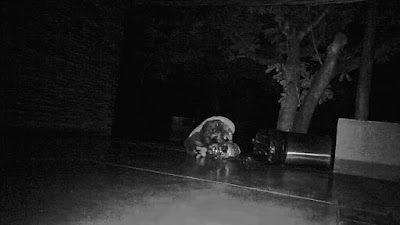
Honey Badger
Honey Badger and the water bottle at Orpen camp
We heard via friends later that day that people who stayed at Tamboti tented camp had a honey badger raid their cooler box. We were astounded to hear it got away with yogurt, cheese and wine! Seems honey badgers tastes are improving. Glenda was wondering if it was in-fact the same honey badger who then came to visit us, (the camps are close in honey badger terms) and perhaps it needed the water after the wine…..


Outside Orpen camp there is a very nice water hole in front of the camp and the general public can view the Orpen Webcam via the internet.

When we arrived there were a few African Elephant (Loxodonta africana) drinking and there was a steady stream of plains game Burchell’s Zebra (Equus burchellii), Impala (Aepyceros melampus),and Blue Wildebeest (Connochaetes taurinus) etc coming through to quench their thirst.

Scene of the Blyde River
Blyde River
We left Orpen in the morning as the following 2 nights / 3 days were spent in Hoedspruit, catching up with old friends and joining our old bird club on their monthly Saturday outing. Great to see many members at the outing and we had a great walk along the Blyde River and being pleasantly surprised by how many species we managed to spot, considering it was mid May. Highlight for a new member was a lifer (first time a bird has been seen by a person) in the form of a male Narina Trogon (Apaloderma narina).

Glenda and I were invited to stay with goods friends on the wildlife estate we used to live in (Raptor's View Wildlife Estate) and made the most of being in the bush and placing our camera trap near their birdbath. Great to see overnight visitors of porcupine, Small-spotted Genet (Genetta genetta), Common Duiker (Sylvicapra grimmia) and two duelling male Nyala (Tragelaphus angasii).

All to soon it was then time to head back into the Kruger National Park and we managed to finally stay in the permanent tents at Tamboti camp overnight. As with Letaba tents they are very comfortable but a little more secluded, they are located on a dry riverbed and there are only 40 tents in total with a central ablution block and shared kitchen area. You certainly feel like you are alone in the bush when staying at these ‘bush’ camps. 


The bush is quite thick around the camping area and we gather in summer it is great for birding. It will be on the list to return to and perhaps spend more time there as we had to make an early start the following day to get to Pretoriuskop Rest Camp.

Tented Camp, Tamboti
Our tent at Tamboti camp
The Kruger Park gets a bit busier when going down to its Southern parts, both with people and animals but we were pleased to finally get to see a pride of 5 Lions (Panthera Leo) on the road between Pretoriuskop and Phabeni gate, especially seeing that we had heard lions roaring most nights. 

It was a good area for us as we then had two good leopard sightings soon after, one with a kill (Impala) which it had managed to drag up a tree reasonably close to the road. 


I managed to practice some macro photograph by finding some butterflies close to the camper, follow the link where you can see the results of my macro photography.

Again …. Time for a little moan about the camping at Pretoriuskop. The camping site is split into two sections and it has always been reasonably comfortable, but now most of the lower camp and a third of the upper camp have been taken over by a tented concession with their permanent tents. Why, I ask !!! It seems the same number of campers can book at the camp but now there is less space. We eventually found a spot near the fence but it was also close to the ablutions, which meant we had people wandering past us at all hours of the night. We were not happy camper ! 

After a pleasant stay in the southern part of the Kruger National Park it was time to head back to Johannesburg to stock up and head off for the next part of our travel. 

Our next blog post (Part 4 Heading west to Kuruman and the Kgalagadi National Park) 

Read : Part 1 - Johannesburg to Phalaborwa

Read : Part 2 - Phalaborwa and Punda Maria


Posted by Unknown at Tuesday, June 27, 2017
Email ThisBlogThis!Share to XShare to FacebookShare to Pinterest

Wednesday, 7 June 2017

Part 2 – Phalaborwa and Punda Maria (May 2017)

African Wildlife and Nature Photographs – (7 provinces in a 7 week trip around South Africa)

Part 2 – Phalaborwa and Punda Maria (May 2017)

As we mentioned in part 1 prior to staying in the Kruger National Park, we spent 3 nights at the Forever Resort in Phalaborwa, due to the park being full. However, this gave us chance to visit friends in Phalaborwa we hadn’t seen in years and allowing us a day visit into the park to Letaba rest camp, one of our favourite Kruger camps. 

The area around Letaba, and moving up to the Northern part of the park is dominated by Mopani bush, a favourite for the parks elephants and we were surprised at just how many elephants we were actually seeing. The most abundant large mammal species in the park are Impala (Aepyceros melampus), a staple diet of the large predators, however we kept saying we were seeing more elephants than impalas, so you can just imagine how many elephants we were seeing. Not that we were complaining as one can spend hours just watching the interaction between these African Elephant (Loxodonta africana) family members, especially when there is a breeding herd with very young calves.

African Elephant (Loxodonta africana) drinking
African Elephants at Punda Maria Waterhole - Kruger National Park
With most of the migrant birds having left South Africa, we were very surprised to find a pair of Woodland Kingfisher (Halcyon senegalensis) in Letaba Camp as these intra African migrants are usually gone at this time of the year (mid May).

South Africa and the Kruger Park have for the past 2 – 3 years suffered from a serious drought but this past year has seen a bit of a recovery in the park which has resulted in an inundation of Red-billed Queleas (Quelea quelea). In all the years we’ve been travelling into the park we have never seen quite so many flocks of Red-billed Queleas swooping through the trees in waves. It has been caused by the apparent late rains late last year and early this year and thus an abundant supply of grass seed.

Burchell’s Coucal - Centropus burchellii
Burchell's Coucal - one of the many
We were also pleased with the number of Southern Ground-Hornbill (Bucorvus leadbeateri) that we saw considering these are regarded as a vulnerable species in Southern Africa, they do however seem to be thriving in the Northern part of the Kruger National Park particularly. Another plentiful sighting were Burchell’s Coucal (Centropus burchellii) and in one day alone we counted 9 which for us was some sort of record. 

Eventually the day dawned for us to move into the Kruger Park and travel from Phalaborwa gate up north to the furthest camp, Punda Maria. Arriving there mid-afternoon after a pleasant drive, counting elephants and Burchell’s Coucals with sightings of the plains game species like, Impalas, Burchell’s Zebra (Equus burchellii) Giraffe (Giraffa camelopardalis) and a few Greater Kudu (Tragelaphus strepsiceros).

This was the first time we’d camped in Punda Maria having previously stayed in the chalets and permanent tents. The camp site is a real treat as the bird hide is located in the camp and it overlooks a beautiful waterhole.

While setting up camp a large herd of elephants came to drink, a great opportunity to take some photographs as they were bathed in soft golden afternoon sun a photographers dream. I stopped what I was doing and rushed to the bird hide to watch them. A fellow traveller advised me they’d been there every day for the last 4 days at the same time. As I was in the middle of setting up camp I thought I might as well catch them the following day. BIG MISTAKE, I was never to see them again in such numbers and in such awesome light in the whole 6 days we were there.. Great opportunity missed. (Lesson: Never leave for tomorrow what can be done today, take your opportunities as they arise). 


One small consolation was the small video footage I took on my mobile phone of the event, which I will share on my website www.africanwildlifeandnaturephotographs.com later. The elephants were constant visitors to the waterhole though and the sounds of elephants communicating in the middle of the night is quite something. Besides the elephants we were lucky to hear and fall asleep to lions roaring every night, but they proved to be elusive when trying to find them during the day.


The advantage of staying in Punda Maria is that it is only an hour’s drive to the Pafuri area, which is one of South Africa’s most prolific birding spots throughout the year , albeit missing the migrant birds in winter. Again, this trip didn’t disappoint with good sightings of African Crowned Eagle (Stephanoaetus coronatus), Martial Eagle (Polemaetus bellicosus) African Fish-Eagle (Haliaeetus vocifer), Meves’s Starling (Lamprotornis mevesii) White-fronted Bee-eater (Merops bullockoides) and White-crowned Lapwing (Vanellus albiceps), to name a few.

Martial Eagle - Polemaetus bellicosus
Martial Eagle at Pafuri - Kruger National Park
Now for a little moan and word of warning; so please take note…we enjoyed Punda Maria for its great location and the wonderful Mahonie Loop around the camp for late afternoon game drives, however the downside of the stay was that the camping was full, possibly overbooked and the camping area was like a car park in a shopping centre, but not as organised…. 

It’s a free-for-all for campers, hence people camping extremely close together, having access to power when not paid for with no control or checking by Sanparks who run the camp. We also soon realised that we were in a pensioner’s discount period (Sanparks have them a couple time a year) meaning there were far too many people camping in the Kruger Park due to its warm winter climate and no doubt cheaper utility costs. Unfortunately, in our opinion, not that interested in the parks wildlife either as some people just parked up and didn’t bother leaving camp, it would seem. 

Sanparks, Punda Maria camp is one camp that should have restricted camping numbers, frequent checking on who has camped where and paid for what. Sadly also there are too few ablutions based on the numbers allowed to camp with some in a poor state of maintenance and repair.

So it was time to say farewell to Punda Maria and head off further south to stay in Letaba and Orpen camps and visiting our previous ‘home town’ of the past few years; Hoedspruit.


Our next blog post (Part 3: Letaba, Orpen area, Hoedspruit and Pretoriuskop)

Read : Part 1 Johanneburg to Phalaborwa

Read : Park 4 Heading west to Kuruman and the Kgalagadi National Park
Posted by Unknown at Wednesday, June 07, 2017
Email ThisBlogThis!Share to XShare to FacebookShare to Pinterest

Monday, 29 September 2014

Bushbuck

Bushbuck (Antelope)

Having a few days off this week, we headed into the Kruger National Park (South Africa). As is most times we enter the gates we wander on the first bird and or animal we will come across. More often or not its the common Impala (Aepyceros melampus) and this this got me thinking, although the most widespread antelope in the Kruger National Park by far, how did it fair in Sub-Sahara Africa? I must admit I was shocked to learn in fact in was the Bushbuck (Tragelaphus scriptus) and (Tragelaphus sylvaticus) that are the most widespread of the Sub-Saharan antelope.
I was further to learn that the Bushbuck were in-fact split into two species (as detailed above) which was something new to me. They are the kéwel(Tragelaphus scriptus) and the imbabala (Tragelaphus sylvaticus). The imbabala is related to the Bongo and the Sitatunga, and the kéwel to the Nyala. Here then in South Africa, the Bushbuck we refer to are (Tragelaphus sylvaticus related to the Bongo and the Sitatunga,  which occur from the Cape of South Africa through to Angola and Zambia.
That over with, other information about the Bushbuck. This antelope is found virtually in all habitats from woodlands to montane forest and rain forest. The Bushbuck found here are slightly bigger than the other species found further North and the colour differs quite substantially with difference in the spots and the stripes in both species but both species have light brown coats, with up to seven white stripes and white splotches on the sides in a variance.
The Bushbuck stands about 90cm (3ft) to the shoulder and depend on male or female weighs between 40-80 Kg (88-176 lbs) as their is sexual dimorphism.

Bushbuck (Tragelaphus sylvaticus) Female - Kruger National Park
South Africa

Posted by Unknown at Monday, September 29, 2014 No comments:
Email ThisBlogThis!Share to XShare to FacebookShare to Pinterest

Monday, 8 September 2014

Steenbok

Steenbok (Dwarf Antelope of South Africa)

Steenbok (Raphicerus campestris) are one of South and Southern Africa’s smallest of antelope but what it lacks in size the Steenbok makes up for in its looks.
Being a beautiful reddish brown in colour, male Steenbok only stand between 40-60 cm (16-24 in)  high and weight in between 10-16 g (22-35 lbs) with the females being slightly smaller. In comparison to the rest of their bodies Steenbok have very long legs, other defining characteristic of the Steenbok is its very large ears and a black triangular patch on the bridge of the nose. You can further distinguish males from females as only males posses short straight black horns  or spikes really which stand about 150cm (6in) in length from the top of its head, large dark eyes, give way to preorbital glands.
Steenbok are solitary antelope and only really come together to mate, although breeding does take place throughout the year, births tend to peak in November and December each year which coincides with ‘Mother Natures re-birth’ (Spring) here in the Southern Hemisphere.
As with a few African antelope Steenbok are primarily browsers, (pick from trees and shrubs) feeding at or near ground level, occasionally they scrape the ground with their sharp hooves for roots and tubers. Water is not essential as moisture can be taken from the food they eat.
Steenbok have many different predators, including Leopard, Caracal and even Pythons, in the presence of danger, Steenbok first hide, crouching with the neck pressed against the ground and ears retracted to avoid detection. If the threat persists or approaches the animal will flee, with fast zig-zagging flight interrupted by attempts at concealment by lying down flat.
In South and Southern Africa the Steenbok’s distribution is wide and varied and can be found in various environments throughout South Africa, Botswana, Angola, Zambia, Kenya, Mozambique, Swaziland, Namibia, Tanzania and Zimbabwe.


Portrait of a Male Steenbok
Male Steenbook (Raphicerus campestris) showing his horns
large ears and 'preorbital glands'

Posted by Unknown at Monday, September 08, 2014 No comments:
Email ThisBlogThis!Share to XShare to FacebookShare to Pinterest

Monday, 1 September 2014

Springbok

Springbok one of natures supreme athletes

Living in South Africa I could not continue to post about the wildlife and all that's offered in the natural world here without posting about one of South Africa's most famous animals synonymous with the country; the Springbok (Antidorcas marsupialis).  The South African ruby union team, called the 'Springboks' have the Springbok emblem of this most agile of animals, along with another well known part of the flora and fauna of the country the 'Protea' flower sewn into their shirts.

The 'Springbok' like the national rugby team are athletes of note. These medium sized antelopes have colouring which consists mainly of a pattern of white, reddish/tan and dark brown, with adult males or 'rams' standing about 80 cm tall (30 in) and about 190cm (72in) in  length. Springbok can reach speeds of up to 100km/h (60mph) and leap 4m (13 ft) through the air which I think you will agree is quite a feat for such a small mammal. Unlike many antelopes, Impala for instance, both the ram (male) and the (ewe) female Springbok have horns which average about 35cm (14 in) in length.

Springbok are also well known for what is known as 'pronking' or 'stotting' which comes from the Afrikaans meaning to 'boast' or 'show off'. The Springbok (Antidorcas marsupialis) with Marsupialis (Latin: marsupium, meaning "pocket") this word being derived from a pocket-like skin flap which runs along the middle of the Springboks back from the tail onwards. This 'marsupium' is best demonstrated when the male Springbok perhaps wants to attract a mate or to ward off any predators, he starts off with a stiff-legged trot, jumping up into the air with an arched back every few paces and lifting the 'flap' along his back.  Lifting the flap causes the long white hairs under the tail to stand up in a conspicuous fan shape, which in turn emits a strong scent of sweat.

Springbok are inhabitants of the mainly dryer parts of south and south western Africa notably in the 'Kalahari' desert in Botswana and the 'Namib' desert of Namibia but also the vast grasslands of South Africa's Free State. Interestingly Springbok are 'mixed' feeders switching between 'browsing' and 'grazing' and by doing this Springbok can meet their water needs and can survive without the need for water over long long periods.

Sprinkbok (Antidorcas marsupialis)
Springbok (Antidorcas marsupialis) Kgalagadi Transfrontier Park

Posted by Unknown at Monday, September 01, 2014 No comments:
Email ThisBlogThis!Share to XShare to FacebookShare to Pinterest

Monday, 18 August 2014

Gemsbok

Gemsbok- Desert Survivalists

If you have been following my last few posts you will know that earlier this year we spent sometime in the Kgalagadi Transfrontier Park. The Kgalagadi is located in a dry arid savanna biome, plants and animal species that inhabit these arid biomes need to adapt to some of the very harsh conditions that prevail in these areas, one such animal species is the Gemsbok  (Oryx gazella).

We encountered many Gemsbok in the Kgalagadi, these magnificent large antelope stand when fully grown at about 1.2m to the shoulder and the adult bulls weighing in at over 300kg. You may think that an animal of this size would indeed struggle to inhabit and survive in what is basically a desert, which by definition is a dry area with very little rainfall and thus available water, often in drought and with extreme heat.

The Gemsbok (Oryx gazella) has evolved and adapted to not only survive in the dry arid areas but thrive in them. One of the most obviously adaptations to living in an area with     very little water is to actually require very little water ones self. In this respect the Gemsbok takes most of its requirement of water from the food it eats. Grasses, roots which they dig up with their hooves, leafy bushes what ever can be found in these dry arid areas you will find Gemsbok close by grazing. Once of course you have taken on water by means of food and or have drunk some the next trick is to retain it, Gemsbok do not sweat and their deifications are dry.

The Gemsbok also has a very distinctive pattern to its coat, continuing research provides us with evidence that the large light colours reflect heat and the dark colours absorb heat, for example one theory is that the large white patch on the belly of the Gemsbok actually reflects heat from the desert sands. To help with the extremes of heat Gemsbok have specialist physiological adaptations, one such adaptation is 'nasal panting', this is a kind of 'heat exchange' where Gemsbok rapidly inhale and exhale through their nose which is lined with small blood vessels called capillaries.

Cool air is sucked in through the nose which cools the blood in these capillaries, in turn this cooled blood is circulated to the brain, where a fascinating part of anatomy is found called the 'hypothalamus' at the brains stem. The 'hypothalamus' oversees many internal body conditions and monitors chemical and physical characteristics of the blood, including body temperature, blood pressure and water content. Through this 'brain cooling action' Gemsbok can then regulate its body temperature by often allowing its temperature to rise considerably during the day and then gradually radiating any surplus heat away through its body as the day goes on and the temperatures cool. Simple other ploys  such as standing with the smallest portions of its body to the sun and largest to any breeze also helps radiate heat away from the body.

The Gemsbok is without doubt a 'Desert Survivalist'

Gemsbok (Oryx gazella)
Gemsbok (Oryx gazella) a Desert Survivalist - Kgalagadi Transfontier Park - South Africa

Posted by Unknown at Monday, August 18, 2014 No comments:
Email ThisBlogThis!Share to XShare to FacebookShare to Pinterest

Monday, 11 August 2014

Kgalagadi Transfrontier Park - (Final Part)

Kgalagadi Transfrontier Park - (Final Part)

We woke early (5am) with sad hearts as this would be our last full day in the Kgalagadi Transfrontier Park as this morning we were leaving Nossob Camp and heading the 161 km along the parks sandy
Nossob Camp Photograph
Gates at Nossob Camp, (hide gate in the middle)
Kgalagadi Transfrontier Park
roads back to Twee Rivieren camp where we would be spending the night. We had decided that we would visit the 'bird hide' which we had tried the previous evening as it is easily accessible from the camp and despite it still being dark at just a little after 5am we would have the benefit of the 'floodlight' as the generator came on at 5am to light up the waterhole.

The temperature had dropped dramatically from the previous days and the wind had picked up quite a bit as we made our way to the hide, again we sat there for just over an hour and nothing to show for it as we shivered in the cold, as others arrived with hot morning coffee. We decided to head back to our chalet and get the car packed and have breakfast before setting off. We left through the 'south gate' just after 7-30 am and as the sun was rising we noticed a lot of cloud cover in the sky, the cooler weather we were expecting a few days earlier had arrived.

Our first stop on the way out of the Kgalagadi Transfrontier Park and back to Twee Rivieren would be 'Dikbaardskolk picnic spot', the picnic spot we had stopped a few days previously on our way from Kalahari Tented Camp to Nossob. This time no sociable weavers (Philetairus socius) nor people, and our coffee and rusks had to be had sat in the car as it was so cold and windy.

We pushed on towards Twee Rivieren still managing to see several Blue Wildebeest, Red Hartebeest
Picture of a Kori Bustard
Kori Bustard with 'neck feathers'
partially extended
and Black-backed jackal along the way. The cloud cover gave our photographs a soft diffused light instead of the golden yellows and oranges we had experience previously. Something worth noting though is that virtually around every corner so far that morning we had caught sight of the worlds 'heaviest flying bird' the Kori Bustard (Ardeotis kori), around 10 in total.  I don't think we'd seen this number in total in a year in the Kruger National Park. Apparently its due to the secretion of 'gum' from the prevalent 'Blackthorn Bushes' in the area. We were fortunate to see a male in a semi mating display (neck feathers extended).

The Kgalagadi Transfrontier Park although famous for its 'lion' and 'birds of prey' has of course many other much smaller mammals that inhabit this stunning arid landscape and we were lucky to see one of theses little inhabitants going about its daily business; a rodent called a Brants's whistling rat (Parotomys brantsii).  Just after our second picnic stop at 'Melkvlei' (still to cold and windy to get out and have coffees and a sandwich) we came across another quite famous inhabitant of the Kgalagadi Transfrontier Park, a family of Meerkats or Suricate (Suricata suricatta). This family entertained us for quite a while, whilst we sat in the car watching and photographing their antics.

Brants's whistling rat photograph
A  Brants's whistling rat, a resident rodent
 in the Kgalagadi Transfrontier Park
Having passed the (famous for its big cats) 'Kij Kij' waterhole (again very quiet) we arrived at the Twee Rivieren camp by mid afternoon our stop for the night and the gateway to the Southern Kgalagadi Transfrontier Park . We checked into our chalet and unpacked the car, as the power doesn't go off in Twee Rivieren unlike the rest of the park and as it was quite chilly in our chalet it was time to bring out our little 'fan heater' we had brought all those kilometers with us from home. We decided not to go out again that day except to the shop to pick up some water (we had used all the water we had brought with us) and catch up on any emails as we now had a 'signal' after several days without contact with the outside world. We had planned to go back to the nearest waterhole at first light in the morning before leaving the park and heading home.

We rose early the following morning so we could make a dash at first light for the 'Samevloeiing' waterhole just a few kilometers inside the Kgalagadi Transfrontier Park gates after entering at Twee Rivieren. What is said about 'best laid plans' etc.... We were met with minus 3 degree temperatures and our 4x4 which had carried us over 2000 km  to date would not start. It took another hour and a half and a 'thick' set of jump leads from our neighbours to eventually get us going. What shall we do? pack and leave or head for the 'waterhole'?

We pulled up at 'Samevloeiing' waterhole all was quiet, then along trotted a Black-backed Jackal for its
Photography of a Meerkat
Meerkat or Suricate
Kgalagadi Transfrontier Park
morning drink and in came the Namaqua Sandgrouse, followed by the Burchell's Sandgrouse weary as ever. The time was moving on and we had to check out at Twee Rivieren by 10am, but the Kgalagadi Transfrontier Park gave us one last surprise before we left, 2 lifer's (birds never before seen). A juvenile Black Harrier (Circus maurus) and a Red-necked Falcon (Falco chicquera) were doing aerial battle just above us, the Harrier we believed was some distance out of its range for that time of the year.

We reluctantly made our way back to our chalet in time to complete the packing and head to the garage to 'pump up' our tyre's back to normal road pressures (when you drive on soft sand tyres need to be reduced in pressure). Final check out at Twee Rivieren gate and we were on our way back home, some 1500km. Kgalagadi Transfrontier Park had given us a week of outstanding wildlife experiences and photo opportunities, with over 25 'lifers' for us, we hope you have enjoyed travelling along with us and we hope we have given you all just a little taste of what you can experience in this wildlife wilderness and area of outstanding natural beauty. One last tip, if you are wishing to go to the Kalagadi Transfrontier Park and experience it for yourselves, then BOOK EARLY, nearly 11 months in advance to ensure you are not disappointed.


Posted by Unknown at Monday, August 11, 2014 No comments:
Email ThisBlogThis!Share to XShare to FacebookShare to Pinterest

Monday, 4 August 2014

Kgalagadi Transfrontier Park – Part 7

Kgalagadi Transfrontier Park – (Part 7) May/June 2014

We had arrived at Nossob Rest Camp in the Kgalagadi Transfrontier Park late in the afternoon the previous day and checked in at the reception with our ‘permit’ still intact and generally checked out our immediate location. There are a few things at the Nossob camp that would be of interest for the first time travellers/photographers to the Kgalagadi Transfrontier Park. Firstly the camp has ‘electrical power’ via its generator daily from 5-30am to 10pm, Secondly it has a shop and petrol, both of these are far and few between in the Kgalagadi Transfrontier Park. Lastly, Nossob has a great ‘hide’ with a made made ‘water hole’.  This hide is located beside the main ‘North’ and ‘South’ gates (more about this later) to the camp and thus is in easy walking distance from the camp. This hide also boasts a webcam which since returning home and checking it out seems to be up and running all the times I have visited. You can find this webcam and other SanParks webcams at the Nossob Webcam.
Yellow Canary (Serinus flaviventris)
Yellow Canary
drinking at 'Cubitje Quap' waterhole
We had done our research and visited the previous afternoon a waterhole about 10km north of the camp called ‘Cubitje Quap’ known for its large flocks of Sandgrouse and Cape Turtle Doves, large Raptors and Black-backed Jackal all coming to drink there as well as some specials like Brown Hyena and Leopard. This waterhole is better for photography first thing in the morning due to the ‘light’ on the waterhole itself and has limited space around the waterhole to take photographs, so we were up early as normal and first at the gate going ‘North’ to get a good location for the mornings visit of the various wildlife species.  Nossob Rest Camp is ‘fenced’ unlike the Khalahari Tented Camp we had previously stayed at and one of only a few camps that are actually fenced in the Kgalagadi Transfrontier Park. Nossob is also a little different to all other camps I have stayed at before, as here you have to actually drive ‘into’ the camp. shut the gate and then open the other gate to continue. So coming from the south you would need to open the South gate, close it and open the North gate to continue your journey or vice versa.
We arrived first at the waterhole just after sunrise and we positioned ourselves the best we could with a good view of the waterhole some 30 meters away, It wasn’t long before a whole host of birds started to arrive, Yellow Canaries (Serinus flaviventris),  Red-headed Finches (Amadina erythrocephala) were amongst the first to appear in their droves, quickly flying in and ‘sipping’ the cool early morning waters and then out again to rest on a nearby bush, hardly resting for a moment before starting over again for a further drink. We soon found out why this curious back and forth of birds continued; it’s due to one of the famous predators of the Kgalagadi Transfrontier Park the ‘Lanner Falcon’ (Falco biarmicus). It swooped in narrowly ‘missing’ a couple of these small birds before returning to its look-out some 100 meters away in an old tree with a good vantage point to see the waterhole.
Next came the birds that have to drink daily in the Kgalagadi Transfrontier Park, the Sandgrouse,
Buchells Sandgrouse (Pterocles burchelli)
Burchells Sandgrouse taking off after taking a drink
at Cubitje Quap Waterhole
circling a few times like ‘bomber command’, flocks of Namaqua  Sandgrouse (Pterocles namaqua) and Burchell’s Sandgrouse (Pterocles burchelli)  came in one after the other to drink and then take off in the opposite direction in which they landed. Again the Lanner Falcon swooped in, this time ‘clipping’ a Namaqua  Sandgrouse but not sufficiently enough to knock it down. This is a deadly scene that is played out daily in the Kgalagadi Transfrontier Park for these birds, a balance based on a need for ‘water’ and a need for ‘food’.
Next up to drink and our only large mammal that morning was the ‘renowned’ scavenger of the Kgalagadi the Black-backed Jackal (Canis mesomelas), This predator was also very nervous as it drank there for a good few minutes, always raising it’s head and looking around every few seconds. We guessed this was to be on the look out for the Kgalagadi Transfrontier Parks apex predators the lions. Unfortunately for us and fortunately for the Jackal none appeared while we were there. We spent most of the morning at Cubitje Quap watching and photographing the comings and goings of the birds and various Jackals.

Later that morning we moved further North to ‘Kwang’ waterhole where it is said to have a large ‘sweet’ waterhole preferred by many animals. Sure enough the hour we sat there, large herds of Blue Wildebeest (Connochaetes taurinus) and Red Hartebeest (Alcelaphus caama)  as well as the occasional Jackal and the now common flocks of birds came to drink.
Black-backed Jackal taking a much needed drink
at Kwang Waterhole
We made our way back to Nossob for lunch and then took ourselves South this time for an afternoon drive to ‘Rooikop’ and ‘Marie se draai’ waterholes. Not a lot happening unfortunately at the waterholes so we made our way back to camp and the hide, again not much happening there either so we decided to comeback later that evening for a second sitting as it was our last night at Nossob Rest Camp as our winter trip to the Kgalagadi Transfrontier Park was nearing an end. The night session was also quite quiet but the highlights were a Verreaux Eagle Owl (Bubo lacteus) which landed some distance from the hide just out past the waterhole and five Bat-eared Foxes (Otocyon megalotis) who also just ran through the area and didn’t stop to drink. We decided to make for our chalet and ensure a nice hot shower and cup of tea and jump into bed before the power went off. Tomorrow we were heading back down to Twee Rivieren Rest Camp and we’d also heard that the weather was going to take a turn and temperature were due to drop.
Posted by Unknown at Monday, August 04, 2014 No comments:
Email ThisBlogThis!Share to XShare to FacebookShare to Pinterest

Monday, 28 July 2014

Kgalagadi Transfrontier Park – Part 6


Kgalagadi Transfrontier Park (Part 6) – May/June 2014


As always we rise early when on a ‘safari’ type vacation or photography shoot and more so on these last few mornings as we were on our first trip to the stunning Kgalagadi Transfrontier Park in South Africa’s, Northern Cape.  The lions and the Black-backed Jackals were, as they had been on previous nights, very ‘vocal’. Would we see them this morning?  My wife and I discuss the possibilities as spotting Kgalagadi Transfrontier Park lion is a highlight of anybodies trip to the park and we excitedly agreed the roars we heard in the night and very early that morning came from the general direction in which we were to travel today.
This morning we were leaving behind the ‘Kalahari Tented Camp’ and surrounding area, where we had spent the last 3 wonderful days and nights, for today we were heading to the ‘Nossob’ rest camp a bit further North into the Kgalagadi Transfrontier Park. A quick breakfast and with the car packed we went through our normal routine of getting our ‘permit’ at the Kalahari Tented Camps reception desk and set off for Nossob.
The sun was just beginning to creep over the sandy dunes of the Kgalagadi Transfrontier Park and we had only been travelling a few minutes down the sandy tracks when my wife spotted him, a magnificent specimen of a male Kgalagadi Lion (Panthera leo) almost blending into the grass as the early morning sunlight bathed both him and the dune grass in a light orange glow. He was almost certainly the male lion we’d heard the previous night and earlier that morning just before daybreak. We tried to manoeuvre to get a better picture of this ‘king’ of the Kgalagadi Transfontier Park but unfortunately we were unable to do so as we had car ‘traffic’ build up behind us and we had a long way to go over the dune roads to Nossob Camp.


Lion (Panthera leo)-Kgalagadi Transfrontier Park

Kgalagadi Lion (Panthera leo) bathed in early morning sunshine.
Due to the distance we had to travel and the condition of the roads (sandy river beds) in the Kgalagadi Transfrontier Park we didn’t want to waste any time so we pressed on down the sandy river bed road of the Auob river heading for our first stop which was the ‘Dikbaardskolk Picnic Area’ which we later found out would be a welcome break. To get there we had to travel south for about 50 km to the ‘Upper’ dune road turning.  Then a further 50km on the upper dune road which traverses across the dunes between the Auob and the Nossob dry river beds.


Photograph of a female Northern-black-Korhaan-Kgalagadi Transfrontier Park

Northern-black-Korhaan (Afrotis afraoides) – Female on the ‘Upper Dune’ road
As we hit the ‘Upper dune’ road the soft rutted sand of the Auob turned to deep hard ‘rutted’ course sand which when travelling at a modest 30km an hour was enough to ‘rattle’ the fillings in your teeth loose. About 3km along this road we sighted, strolling in front of us, a male and female Northern Black Korhaan’s, (Afrotis afraoides) the more colourful male unfortunately disappeared into the dune grass but the female gave us some great photographic opportunities. Continuing along the ‘road from hell’ it wasn’t only the ‘fillings’ that were being affected ‘bladders’ were also telling us to hurry along to the ‘Dikbaardskolk Picnic Area’. Ant-eating-Chat (Myrmecocichla formicivora) were common place along the road as well as Fawn-coloured Larks (Mirafra africanoides) and of course the ever present Pale Chanting Goshawks (Melierax canorus). The Kgalagadi Transfrontier Park never had such a welcome sight as the turn into the ‘Dikbaardskolk Picnic Area’ and an end to the ‘Road from Hell’ or the Upper Dune Road.  The time was already approaching midday and we had travelled just the 100km since leaving the Khalahari Tented Camp at 7:30am that morning.


Photography of Dikbaardskolk Picnic Area-Kgalagadi Transfrontier Park

Dikbaardskolk Picnic Area -Kgalagadi Transfrontier Park – South Africa
‘Dikbaardskolk Picnic Area’ was in a spotless condition and the toilets were well stocked with hand soap and toilet paper, a credit to Sanparks as basically we were at least 50 km from the nearest main camp Nossob (our destination for the next few days). In the Kruger
National Park at picnic areas Chacma Baboons (Papio ursinus) and Vervet Monkeys (Chlorocebus pygerythrus) tend to be a problem as people often feed these wild animals, who in turn become aggressive and a nuisance around food. DO NOT FEED WILD ANIMALS ..ok rant over, here at ‘Dikbaardskolk Picnic Area’ the problem wasn’t a primate but a bird, the ‘Sociable Weaver’ (Philetairus socius). These birds were everywhere, perching on your head as you sat to try and have a bite of a bun or sandwich. They even tried to take the bun from my wife’s hand as she ate. Amazing little birds though as they were followed around by their ever hungry chicks.
After our short break we pressed on towards Nossob rest camp, now on the dry sandy river bed of the ‘ephemeral’ Nossob River (they only flow for a short period and then only in really good rainy seasons). The Kgalagadi Transfrontier Park really is diverse and good sightings of Black-shouldered kite (Elanus axillaris) who were busily feeding on one of the many rodents that inhabit the park. Herds of Sprinkbok (Elanus axillaris) and Gemsbok (Oryx gazella) were in great number all the way to Nossob Camp. We arrived at the camp after travelling the last 50 km at about 3pm in the afternoon and checked in to our chalet, unpacked the car which started our next leg of our trip to the Kgalagadi Transfrontier Park, Nossob Camp.
Posted by Unknown at Monday, July 28, 2014 No comments:
Email ThisBlogThis!Share to XShare to FacebookShare to Pinterest

Monday, 30 June 2014

Kgalagadi Transfrontier Park - Part 4

Kgalagadi Transfrontier Park (Part 4) - May/June 2014 – Kalahari Tented Camp (Day 1)

Having traveled well over a 1000 km (600 miles) to get to the Kgalagadi Transfrontier Park this would be our first full day actually in the Kgalagadi Transfrontier Park proper. As we’d been woken early by the roars of the famous Kalahari black-maned lions close to the outside of our tent, we were up and had breakfast and packed ready for a mornings photography/game viewing and ready to depart by the 7-30am stipulated gate exit time at this time of the year (winter). It was cold, very cold about 5 deg C but clear and as the sun was rising we could see it was going to be a great day.

After collecting our ‘exit permit’ which is a golden rule in the Kgalagadi Transfrontier Park (They will ask you where you are going and in case you do not return by the time the gate closes, which is metaphoric as there are ‘no gates or fences’ at the ‘Kalahari Tented Camp’ they will come to search for you) we thought we would head for the ‘Dalkeith Waterhole’ which we briefly discovered the day before on our journey in. We also thought we would drive at a slow pace to Dalkeith as it was only about 21 km away this would give us time to game view on the way as may birds and mammals were to be seen.

Scaly-feathered Finches (Sporopipes squamifrons)
Scaly-feathered Finch
(Sporopipes squamifros)
We set off on the sandy dry riverbed road of the Auob river towards Dalkeith Waterhole which is identified as one of the better waterholes of the Kgalagadi Transfrontier Park. Travelling at about 20 km hr we started to see many of the bird species we had missed the previous day, Scaly-feathered Finches (Sporopipes squamifrons) lined our way perched on the shrub, hoping along the ground in and out the shrub were Kalahari Scrub-Robin (Erythropygia paena). Sat in the dry Auob river bed itself bathed in our early morning light was a Black-backed Jackal (Canis mesomelas) many Springbok (Antidorcas marsupialis), Blue Wildebeest (Connochaetes taurinus) and Gemsbok (Oryx gazella) were dotted about on the dune banks.

Life in the Kgalagadi Transfrontier Park is somewhat slow, it took
Black-backed Jackal (Canis mesomelas)
Black-backed Jackal
(Canis mesomelas)
us 2 hrs to arrive at ‘Dalkieth Waterhole’. A couple of cars had already parked up as we took our position ready for any action that may happen, immediately ‘mixed flocks’ of small birds perched in nearby bushes which included Red-headed Finches (Amadina erythrocephala) and Yellow Canaries (Serinus flaviventris) rushed to the waterhole to drink only staying for a few seconds to drink, before flying back to the relative safety of the bushes. This is due to the ever present ‘birds of prey’ like the Lanner Falcon (Falco biarmicus) who also frequent these waterholes but for very different reasons.

During the ‘winter months’ especially in the Kgalagadi Transfrontier Park, all animals and birds at sometime or another come to the man made waterholes to drink, today was no exception although while at the waterhole we didn’t see any of our preferred mammals drinking,like the lion, leopard, cheetah or brown hyena but we did see herds of Gemsbok and Wildebeest come and quench their thirst in this beautiful desert park.

Red-headed Finches (Amadina erythrocephala)
Red-headed Finch
(Amadina erythrocephala)
We headed back to camp for some lunch and a snooze (hard work this wildlife photography lark) before setting off to the main camp some 3km away called Mata Mata. There are only 3 main camps in the Kgalagadi Transfrontier Park where you can get ‘power’ and Mata Mata was one of them. We needed to recharge our camera and laptop batteries. We visited the camp shop to see what we could find and came away with the obligatory mug saying ‘Kgalagadi Transfrontier Park’ on the side.
Blue Wildebeest (Connochaetes taurinus)
Blue Wildebeest
(Connochaetes taurinus)
 

We headed for another small waterhole close to camp ‘Sitzas’ where we had seen the Secretarybirds (Sagittarius serpentarius) on our way to the camp the day before. We sat there enjoying the late afternoon sun with only a lone springbok to keep us company for the time we were there. Heading back to camp as the sun was setting to enjoy another ‘sundowner’ (drinks as the sun goes down) on our deck pondering our day and thinking about the ‘Milky Way’ I hoped I would see that night.


Posted by Unknown at Monday, June 30, 2014 No comments:
Email ThisBlogThis!Share to XShare to FacebookShare to Pinterest
Older Posts Home
Subscribe to: Posts (Atom)

About Me

Unknown
View my complete profile

Contact Form

Name

Email *

Message *

Subscribe To

Posts
Atom
Posts
All Comments
Atom
All Comments

Blog Archive

  • ▼  2017 (4)
    • ▼  July (1)
      • Part 4 - Heading west to Kuruman and the Kgalagadi...
    • ►  June (2)
    • ►  May (1)
  • ►  2014 (52)
    • ►  November (1)
    • ►  October (2)
    • ►  September (5)
    • ►  August (4)
    • ►  July (2)
    • ►  June (4)
    • ►  May (4)
    • ►  April (4)
    • ►  March (8)
    • ►  February (9)
    • ►  January (9)
  • ►  2013 (4)
    • ►  December (4)

Categories

  • Amphibians (2)
  • Antelope (13)
  • Augrabies Falls National Park (2)
  • Avian (34)
  • Big 5 (3)
  • Big Cats (2)
  • Birding (35)
  • Birds (35)
  • Camping (3)
  • Carnivore (6)
  • Coordinated Water Bird Count (1)
  • Dung Beetles (1)
  • Forever Resort (1)
  • Frogs (1)
  • Honey Badger (1)
  • Insects (1)
  • Kathu (1)
  • Kgalagadi Transfrontier Park (14)
  • Kruger National Park (30)
  • Lenstag (1)
  • Letaba Restcamp (1)
  • Little 5 (1)
  • Mammals (24)
  • Mating (4)
  • Meerkat (1)
  • Migration (5)
  • Nature (49)
  • Pafuri (1)
  • Phalaborwa (2)
  • Pretoriuskop (1)
  • Punda Maria (1)
  • Redsand Country Lodge (1)
  • Reptiles (2)
  • Rietvlei Nature Reserve (2)
  • Road Trip (4)
  • Rodents (1)
  • South Africa (53)
  • Tamboti (1)
  • Ungulates (2)
  • Wildlife (58)
Follow this blog
All images and text are copyright of © Tony Sparkes. Simple theme. Powered by Blogger.