Monday, 28 April 2014

Zebra

Zebra - Horses of the Savannah

Plains Zebra, (Equus burchellii) also known as Burchelli's or the common Zebra are one of the iconic savannah or plains herd mammals we have all come to associate with an African safari. 

I captured these Plains Zebra, which were part of a much larger herd while on what one would call a typical 'safari self drive' in South Africa's Kruger National Park. That day alone my wife and I must have encountered in various Zebra herds and groups somewhere between 500-700 animals just in a small section of the park.

Photograph of three Plains Zebra, (Equus burchellii)
Plains Zebra, (Equus burchellii) also known as the Burchell's Zebra

Monday, 21 April 2014

Bateleur Eagle

Bateleur Eagle – Majestic Eagle of the Savannah

The Bateleur Eagle (Terathopius ecaudatus) is a medium sized eagle of the African Savannah. Endemic to Africa this very colorful eagle is unmistakable in flight, with its very short tail (ecaudatus is Latin for tailless) and distinctive soaring and flight pattern, colorful plumage and white under wings the Bateleur Eagle is easy to spot soaring high and sometime not so high in the African sky’s.

Photograph of a Bateleur Eagle (Terathopius ecaudatus) on the ground Kruger National Park
Bateleur Eagle (Terathopius ecaudatus) - Kruger National Park, South Africa


Monday, 14 April 2014

Impala

Impala - Africa's Fast Food

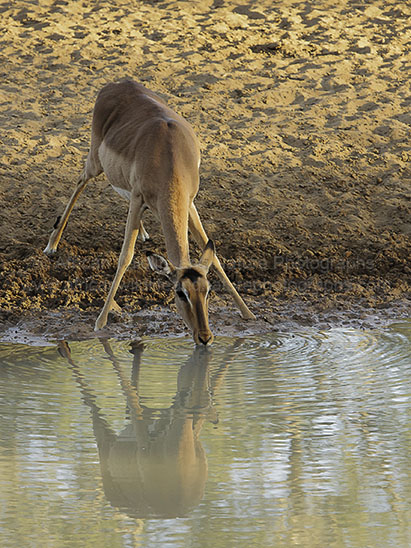
Anybody who has been on an African safari will probably come across quite quickly in their game drives the humble Impala antelope (Aepyceros melampus). These medium sized antelope have two recognised sub-species that being the common Impala (Aepyceros. melampus) and the black-faced Impala (Aepyceros melampus petersi) of Angola and Namibia.
The Impala is an animal of the great African savannah and woodland edges from where it can seek cover and as this is the Impala's natural habitat it has become a great 'prey' favourite of the big African cats like the Lion, Leopard and Cheetah, with this in mind those on safari often see these antelope at large cat 'kill' sightings.
Photograph of a Impala Antelope (Aepyceros melampus) drinking from a water hole
Impala (Aepyceros melampus) female drinking from a waterhole, a daily occurrence.


Monday, 7 April 2014

Double-banded Sandgrouse

Double-banded Sandgrouse – Multi-coloured birds of Southern Africa

It was a few years of birding before we saw our first  Double-banded Sandgrouse (Pterocles bicinctus) I can remember how excited we were at seeing this stunning multi coloured bird up close and personal. 

Being found in the most arid parts of South and Southern Africa and as with many of our birding experiences our Double-banded Sandgrouse was spotted driving along a dirt road towards the northern part of South Africa’s Kruger National Park.

Photograph of a male Double-banded Sandgrouse (Pterocles bicinctus)
A male Double-banded Sandgrouse (Pterocles bicinctus)

Monday, 31 March 2014

Nile Crocodile

Nile Crocodile – The largest reptile in Africa

The Nile Crocodile (Crocodylus niloticus) is the largest of any reptile in Africa, in fact the Nile Crocodile is the second largest of all living (extant) reptiles in the world, second only to another crocodile the Saltwater Crocodile (Crocodylus porosus).

When we look at the sheer size that can be obtained by the Nile Crocodile, specimens have been measured at over 6m (20ft) in length and weighing in at over 900kg (2000lb) we see how intimidating and deadly the Nile Crocodile can be to its prey.

Picture of a Nile Crocodile (Crocodylus niloticus)
Nile Crocodile (Crocodylus niloticus) Lake Panic - Kruger National Park

Monday, 24 March 2014

African Spoonbill

African Spoonbill (Platalea alba)

Being endemic to Sub-Saharan Africa and Madagascar the African Spoonbill (Platalea alba) is one of the most easily conspicuous and recognisable of birds, I say this is due to its extraordinary ‘bill’ which looks like a pair of long grey ‘paddles’ attached to its face.

With these paddles (or ‘spatulated’ bill) the African Spoonbill, continually forages in the freshwater wetlands, pans, rivers and flood plains for its food which consist of small fish, crustaceans, molluscs and insects.

Photograph of African Spoonbill (Platalea alba) stood in shallow water
African Spoonbill (Platalea alba)

Thursday, 20 March 2014

African Giraffe

African Giraffe the tallest living land animal


The giraffe (Giraffa camelopardalis giraffa) is often passed by, by those either on safari for the first time after a few encounters or by those who like me spend a great deal of their time in the bush. The giraffe is one of my favourite and most interesting of animals to photograph as you can normally get quite close to them, especially in the Kruger National Park wher I take a lot of my photographs. 

Giraffe has many ticks against its name, besides being the tallest land animal they are for instance the tallest of the even toed 'ungulates' and also the largest 'ruminant'. Their are around 9 sub-species of giraffe but the one shown below is the South African Giraffe (Giraffa camelopardalis giraffa).

Photograph of a South African Giraffe (Giraffa camelopardalis giraffa) stood in long grass
South African Giraffe (Giraffa camelopardalis giraffa) - Kruger National Park

Monday, 17 March 2014

Southern Yellow-billed-Hornbill


The Southern Yellow-billed Hornbill (Tockus leucomelas) is one of about 10 Hornbill species that can be found in South and Southern Africa.  The Southern Yellow-billed Hornbill is along with the Red-billed Hornbill the most common of the Hornbill species in South Africa.

The Southern Yellow-billed Hornbill is found mainly in broad leaf woodland which in South Africa is in mainly in the far north east of the country. The Southern Yellow-billed Hornbill is a medium sized bird around about 50-60cm (18-24in) in length and feeds on the ground catching spiders,insects, scorpions and seeds.

The female Southern Yellow-billed Hornbill nests in a suitable hole or hollow in a tree which is sealed up by the male with as small gap from which he feeds her through. The female Southern Yellow-billed Hornbill also looses all her feathers while sealed in her nest hollow. Therefore if something should happen to the male Southern Yellow-billed Hornbill the female would not only starve also possibly her chicks, but she would also not be able to  get out and fly away or feed herself.

Photograph of a Southern Yellow-billed Hornbill (Tockus leucomelas) perching on a branch.
The Southern Yellow-billed Hornbill (Tockus leucomelas)